
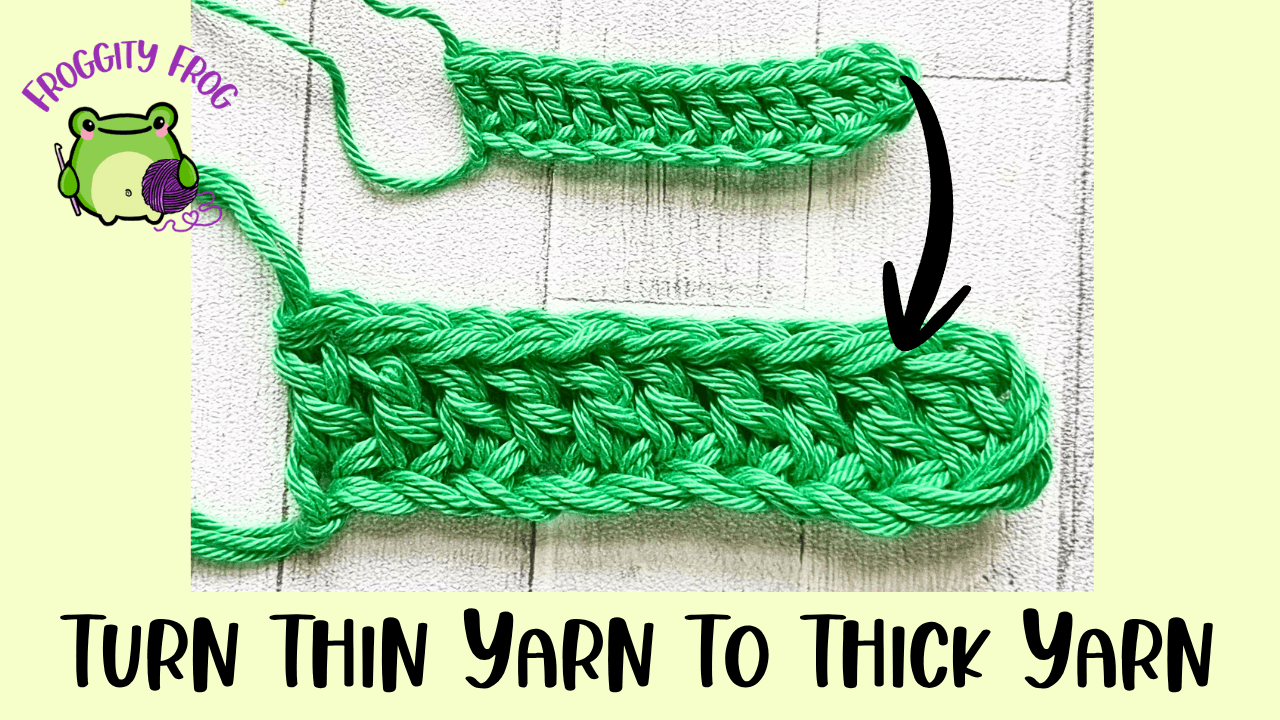
Over the years we buy balls of yarn that catch our eye and that look pretty. Sometimes without a thought as to what we can use them for or if that weight of yarn is really what we want. Or we get gifted random balls by well meaning relatives in weights that are too thin for our liking. So what can we do with these really thin yarns? How about turning your thin yarn into chunky yarn with this quick and easy trick that triples up your yarn but requires no endless unravelling or cutting of your yarn? Best of all, the technique of chain plying only needs one ball of yarn.
Watch how to do it in the video below, or keep reading for more about the method, plus written steps with a picture guide and how to work out what hook size you’ll need.
Click here for the left hand video
What Is Chain Plying?
Chain plying, also called Navajo plying, was originally a technique for spinners to turn a single strand into a 3-ply yarn, but it’s been adapted to work for crocheters too.
It’s a deceptively simple way to instantly turn a thin yarn into a much chunkier 3-ply yarn just by folding the yarn in a particular way and pulling your working yarn through the new loop you create. I’ll show you exactly how below in pictures, or watch the video above.
The best part of chain plying is that you can make a 3-ply strand of yarn just by pulling your yarn from a single ball. There’s no cutting or unravelling needed.
Because you chain-ply as you go, there’s no need to chain-ply the whole ball of yarn and wind it into a new one before you start. It’s a quick, simple and fuss-free way to transform your thin yarn into chunky yarn.
How to Chain-Ply
Start by pulling out a length of yarn from your ball and laying it on a flat surface. You want to make the shape of an S with it (if you’re left-handed, you want to make a backwards S shape). See the pictures below.
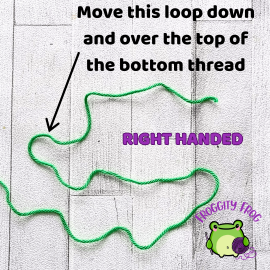
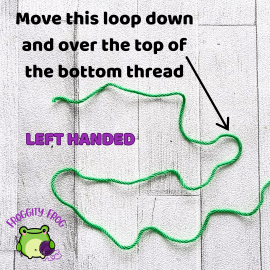
Now pull the top left loop down over the lowest part of the S (for left-handers, you’ll be pulling the top right loop down).
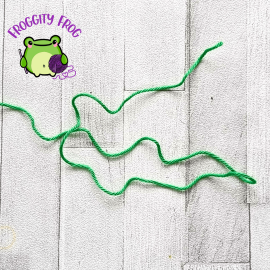
Now grip the part of the yarn with your tail and with your other hand pull the lower thread through the loop that has been created. Pull your loop out as long as is comfortable for you; there’s no set length, so it’s entirely up to you.
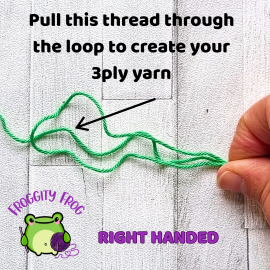
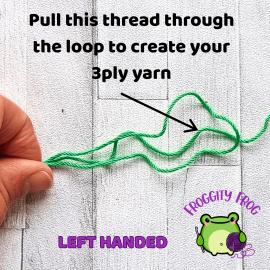
You now have a 3-ply yarn. Now you create your slip knot like you would with any other type of yarn and start crocheting as you normally would.
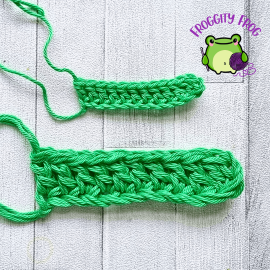
When you reach the end of your new chunky yarn, you just pull more of the thread through that loop to be able to keep crocheting.
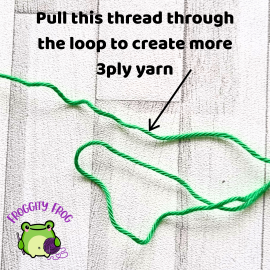
That’s it! Watch the video above to see me work through this.
What Hook Size Do You Need for Chain-Plied Yarn?
So how do you know what hook size you will need? When you’re using yarn straight from the ball it’s easy: you just use the hook size your yarn recommends. But here we’re creating a new type of yarn, and that doesn’t come with any hook size guide.
Fortunately, there’s a handy rule of thumb: use a hook that is 1.7 times the size of the hook on your yarn label.
So if you start with a yarn that needs a 2.5mm hook (between a US B-1 and C-2), you should try a 4.5mm (US 7) hook after you chain-ply. In the video you’ll see me do this, but as it turns out, it felt too small for me, so I went and found a 5.5mm (US I-9) hook and that felt much more comfortable to use. This rule is just guidance, and you shouldn’t be afraid to play around with hook sizes a bit to find what’s going to be the best for you to use for your project.
Hook on your yarn label | Hook to try after chain plying |
|---|---|
| 2mm | 3.5mm (E-4) |
| 2.25mm (B-1) | 3.75mm (F-5) |
| 2.5mm | 4.5mm (7) |
| 2.75mm (C-2) | 4.5mm (7) |
| 3mm | 5mm (H-8) |
| 3.25mm (D-3) | 5.5mm (I-9) |
| 3.5mm (E-4) | 6mm (J-10) |
| 3.75mm (F-5) | 6.5mm (K-10.5) |
| 4mm (G-6) | 7mm |
| 4.5mm (7) | 8mm (L-11) |
| 5mm (H-8) | 9mm (M/N-13) |
The reason this is a rule of thumb rather than something fixed is that not all yarn is made equal. There’s actually quite a bit of difference in thickness between yarns that recommend the same hook size. When you chain-ply, that small difference gets tripled up too, so the gap in thickness between the two finished yarns is much bigger than it was to start with. That can easily be enough to mean you need a different hook size.
Of course, personal preference always plays a part in selecting which size hook you will use. If you want a tighter finish for your fabric that feels denser, then you use a smaller hook; if you want your fabric to have a looser, more breathable finish, then you choose a larger hook. Choose the hook you’re most comfortable with and that gives you the finished feel you want.
Deciding what kind of fabric you want to create depends on what project you’re making. A basket will need a denser fabric to keep the walls standing up straight. However, if you’re making a cardigan, you may well prefer a more flexible, breathable fabric.
What Can You Make with Chain-Plied Yarn?
Anything, as long as you’ve got enough yarn!
Once you know what hook size your new chunky yarn needs, you can search for crochet patterns that need that thickness of yarn. Ravelry allows you to search for patterns by hook size and by yardage (the amount of yarn a pattern needs).
Yardage is an important one, because you are going to have to be careful about how much yarn you now actually have. Your original ball of yarn might have 100 metres (about 109 yards) of yarn in it, but because you’ve just tripled your strands, you’re only going to have about 33 metres (36 yards) of chain-plied yarn. So when choosing your pattern, be careful to check how much yarn you’re going to have to make it.
Chain Plying FAQs
What happens if I chain-ply variegated yarn?
You won’t easily get the stripes of the three strands lined up, so instead you’ll get a marled effect where the colours of each strand of yarn mix together.
How long should my loops be?
I’d pull your loops out as long as is comfortable for you. There is no minimum or maximum length that you need to pull your loops out to, so it’s entirely your choice.
Can I chain-ply any type of yarn or fibre?
Yes, this should work for any type of yarn.
Can I join a new ball of yarn partway through?
You can join a new ball of yarn in the same way you would normally. Start chain plying your new ball, and pull the plied yarn through the last 2 loops of the last stitch you made with the old ball.
Will chain-plied yarn work in any pattern?
Yes, just be wary of your hook slipping in between the individual strands if working post stitches or into just one of the loops.
Give Chain Plying a Try
So next time you find a ball of thin yarn lurking at the bottom of your stash, you know exactly what to do with it. Give chain plying a try!
If you’d like more crochet tips and tricks like this, sign up to my free newsletter here to be the first to know when new articles and videos get posted.


0 Comments